

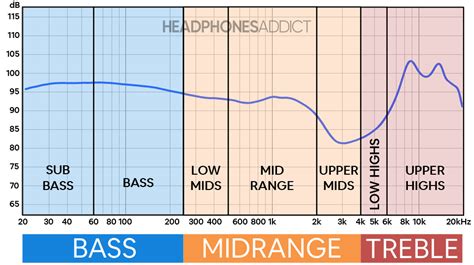
Given the curves above we might assume that easily audible differences between different speakers (and headphones) are a given. Speakers and headphones are at the end of the audio chain. Can we apply an objectivist lens here? Can we say that the “best” speakers will have the flattest FR and the lowest distortion?
We do have a little evidence that speaker preference may be positively correlated with objective measures of speaker quality. In “Loudspeaker Measurements and Their Relationship to Listener Preferences: Part 2” Floyd Toole describes an experiment where trained listeners were asked to rate different speakers presented randomly. Overall the speakers with the objectively better measurements were more highly rated. Overall these better speakers tended to have flatter frequency responses. Audio manufacturer Harman (https://www.youtube.com/watch?v=xEZkz4Li-0M) are one of the few companies that use blind testing when developing their speakers.
Things to not worry about: Jitter
The other side of this is that it is fatuous (and often very expensive) to be concerned with sources of distortion that are fundamentally inaudible. The current Audiophile monster under the bed is Jitter. Jitter is a distortion created by timing variations in digital samples. A DAC outputs a stream of samples controlled by a very accurate “clock” (much like the “clock” in a computer processor) . In theory the samples should be output at a precise rate so if the signal was sampled at 44.1Khz the samples will be output at exactly 44,100 samples per second. If the clock controlled DAC consistently outputs samples slightly less often or sightly more often we will simply not notice it.
If however the intervals between the samples vary then this modulates the output leading to distortion.
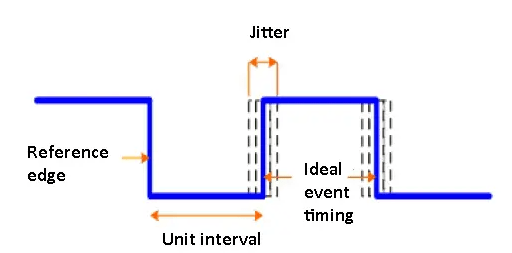
This much is not controversial. The question becomes what magnitude of Jitter (measured in nanoseconds or picoseconds) is audible. This is part of a general issue viz just how good is human hearing.
We can address this question from either a theoretical or practical standpoint. There have been multiple attempts to derive models of audibility.
Julian Dunn created a model where the audibility of Jitter was expressed as the amount which led to the effective bit depth falling beneath the nominal level, this varies with the frequency of the audio signal where jitter has a greater effect at the extreme of human hearing (20Khz). For Dunn 10ps of Jitter would degrade the signal below a nominal 16 bit level (the bit depth used by CD audio).
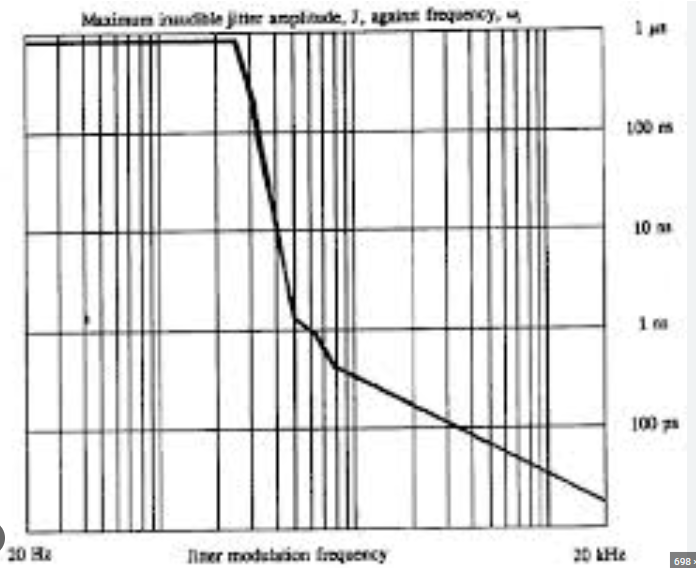
This model however was never verified in empirical listening tests. Also analysis of Dunn’s model show that even this pessimistic thesis depends on the signal level being at over 120db above the threshold of hearing, i.e. close to or above the threshold of pain.
But, is Jitter actually audible as distortion? Well yes of course it is at a sufficient magnitude. However to date no credible well proctored empirical double blind tests have indicated that the level of jitter present in competently engineered consumer digital audio equipment is remotely audible.
Of course even if something is not a problem there will always be some who will cash in on such audiophile worries to supply solutions such as high frequency external reclocking devices even devices to reclock USB data.
Things to really not worry about: Line level (RCA) interconnect cables
Many years ago I was quite active on a audio forum headfi.org. This forum was concerned with discussion of headphone related audio issues. One of the subforums dealt with “Audio Science”. At the time the prevailing consensus in the other subforums was that there were clearly audible differences between different interconnect cables such as the cables used to connect a digital to audio converter (DAC) or a CD player to an amplifier. This attitude is seen in many audio publications. If you could not hear these differences either you had poor hearing or your system was not good enough.
The problem with such assertions is that they were seldom evaluated with any rigor. Typically a listener would listen to different cables with a full knowledge of which cables they were, how they were constructed, their physical appearance and of course what they cost. If you have the readies you can spend $16,000 for a one meter interconnect cable https://www.transparentcable.com/products/opus-rca-interconnect
By and large the more expensive the cable was the better it was reviewed. You would see terms such as detailed, timing, spatial precision, extension, three-dimensional, tightly focused images, resolution, tonal neutrality, coherence and claims of improvements in the dynamic range or attack time. All of this is evaluated by simple uncontrolled listening often comparing B with A sometimes when A has not been used in several hours or even days.
But if there are audible differences between interconnect cables where do they come from? Well, there are really only 4 properties that we need to be concerned with (Resistance, Capacitance, Inductance, and Shielding). Poor shielding can allow noise breakthrough (easily measured, as are the other properties) and a really really pathologically thin conductor can act as a filter.
Of course if you want to make a cable that alters (specifically makes it worse) the transmitted signal it is easy to do so. Several cable makers have included mysterious black boxes in their cables. Some CD player manufacturers (in the past) even tuned their players to have a significant roll off. But, if you want to alter the sound of your system why not just buy an equalizer.
In my days as Nick Charles on the headfi.org forum I once did a set of fairly crude measurements of the differences between RCA cables. I took the output from a CD player passed it through an ADC and recorded it as a wav file which could then be analyzed and the data exported to spreadsheet. if cables made a difference the measured spectra should show a notable difference either visually or from a statistical analysis.
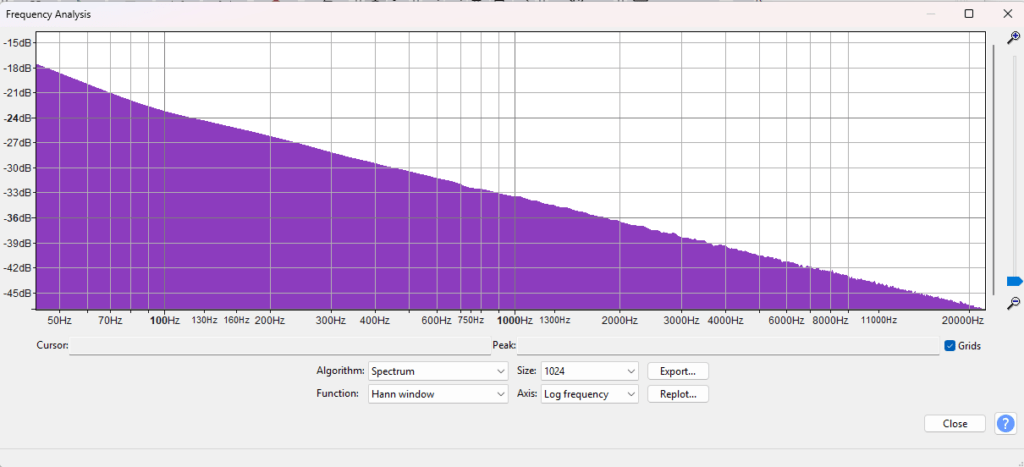
Apart from the $0.77 cable with poor shielding (some extra low level noise) there were really no differences in frequency response between conventional cables at widely varying price points. None of the cables altered the frequency response of the signal to any notable degree, they all had basically flat responses. If a cable has a FR that is substantially not flat that will be easily measurable and possibly audible.
Admittedly these tests were very crude and with some acknowledged methodological limitations. But, the basic pattern has been backed up by much better audio experts (see the work of Ethan Winer and his null device) , apart from faulty cables there really is no audible difference between any 2 competently produced interconnects cables at line level at any price.
Those who think that cables really (a priori) make a difference of course have several arguments to fall back on. First there is the “we cannot measure all the audible properties”, i.e. measurements of noise, distortion and linearity are insufficient. Something, some generally vaguely defined property (clarity, speed etc.) that I can hear cannot be captured. See the writings of Carl Sagan (Dragon in the garage).
Then there is the “your equipment is not good enough to show the differences”. So these obvious “night and day” , drastic, eye-opening differences between cables disappear unless you have a $20K source and $30K speakers and/or your recording device with noise levels at or below -100db is simply too imprecise to capture the differences. Then your hearing is “not good enough” if you do not hear the differences that they do.
Back in the early days of consumer digital audio Ivor Tiefenbrun (Linn Audio) was a fervent anti digital advocate ( he believed that the presence of a digital clock in a room would degrade audio). He was famously incapable of detecting the presence or absence of a 16 bit A/D/A (Sony PCM-F1) loop added into a vinyl playing system featuring his LP12 turntable.
Then how about a middle ground? Show that there are audible differences between non pathological cables by using double blind tests. For most of the cable difference fraternity this is a no no, double blind tests are unnatural or too stressful and they end back at “I hear a difference when I know what I am listening to and therefore there is a difference”.
Anyone with even a passing acquaintance with human psychology will tell you that there are many things that can easily affect (bias) our perception that are not related to the actual stimulus. Food coloring for one. For cables these include (at least) knowledge of cost, physical appearance, “expert” reviews and marketing information (even when nonsensical).
Leave a Reply