

I am pretty much an objectivist here. I am a recovered subjectivist. If two amplifiers sound very different (verified with carefully controlled Double Blind Tests and less common than you might think) then: (1) It is a matter of Physics not some fuzzy vague magical property and (2) at least one of them is probably sub optimal. We leave aside speakers/amplifiers with pathological impedance matching issues.
The purpose of an amplifier (from an objectivist perspective) is to take a low level signal and amplify it enough to be able to drive transducers such as speakers or headphones without altering the fundamental signal in any other way. The exception to this rule is the phono preamplifier stage which must alter the signal according to a well defined “curve” (RIAA curve) to overcome the physical limitations of vinyl records.

Of course it is eminently possible to make an amplifier that has a distinctive sound (see the Carver challenge) and certainly a lot of valve and even some early solid state integrated amplifiers (such as my old low powered Rotel RA211) did have pretty poor noise and distortion levels. However this technology is now really mature. Making an amplifier with a flat frequency response, low distortion, and low noise should be trivial.
“What about speakers?” I hear you say. Well, in the league table of audible differences between devices then speakers are right at the top with a +200 goal difference. Speakers (and headphones) are far and away the largest potential source of deviations from transparent for any class of audio device (excluding vinyl related devices).

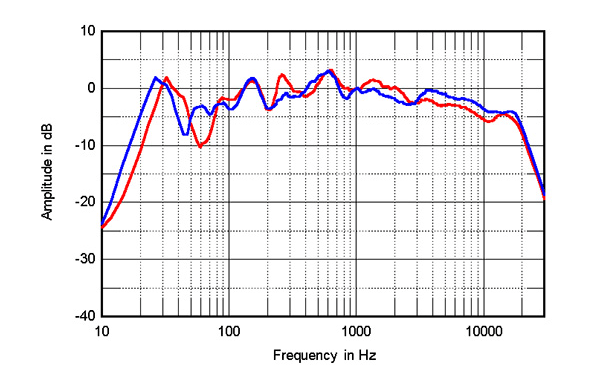
The above are the Frequency Response curves for three different loudspeaker pairs ranging from $7K to $14K chosen at random. These are actually pretty good in the scheme of things but would be considered awful for Amps and digital sources.
Leave a Reply