

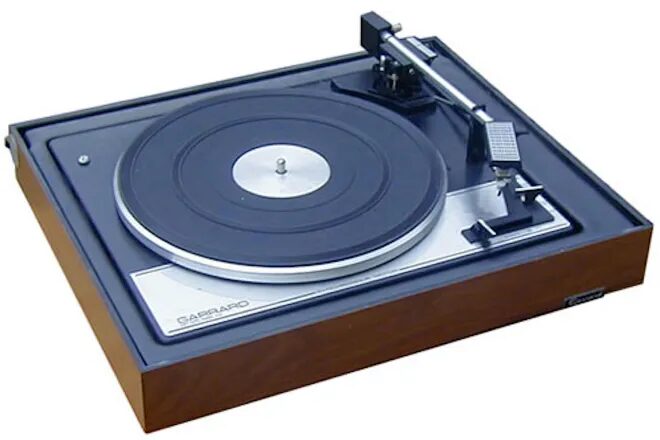
My first memory of listening to a record player was about 1969, it was a very primitive portable player. As my dad improved his Audio system he gave me his older kit which included a Garrard SP25 MK IV turntable (pictured above) and a Rotel 211 amplifier and I bought myself a pair of Solarvox TK19 speakers. Over the years I upgraded the kit ending in early 1984 with a Rega Planar 3 with RB300 tonearm and Nagaoka MP11 cartridge, A&R A60 Amplifier and Kef Coda MKII speakers. Not high end stuff by any means. But something bugged me. The system was very noisy. I was listening to a lot of classical music which tends to have a good dynamic range. With the quieter passages the noise was really annoying. It was not just surface noise(though that was bad enough) , the Rega exhibited very audible levels of rumble.
I should have just taken it straight back to the shop. What else could I do about it? The first option was to try and fix the noise. I experimented with adjusting the TT, changing the bearing and oil. Nothing helped. The next option was upgrading the TT again. . But the Rega was a lot of money to me then and a meaningful upgrade would have been something like the Linn Sondek LP12.
Although CD players had been around in the UK since march 1983 I had not heard one and there were few models on the market. In late 1984 setting myself a budget of £400 I ambled off to Charing Cross Road records (84 Charing Cross Road, London) to audition one or two affordable CD players. I asked to listen to recording of Mahler Symphony no 1 in D (Titan), they brought out the Solti, Chicago Symphony Orchestra Decca recording (sadly lost, but replaced). What I did not hear was jaw dropping.
In the opening movement which starts very quietly I heard no extraneous noise at all, just silence and then slowly the music. It also sounded unbelievably clear. I was hooked. I had a choice of two players both were basically rebadged SONY CDP101 players. I opted for the cheaper Marantz CD63B rather than the Meridian CD101B (with extra bits) which left me £100 to buy 10CDs, the Mahler plus another 9.
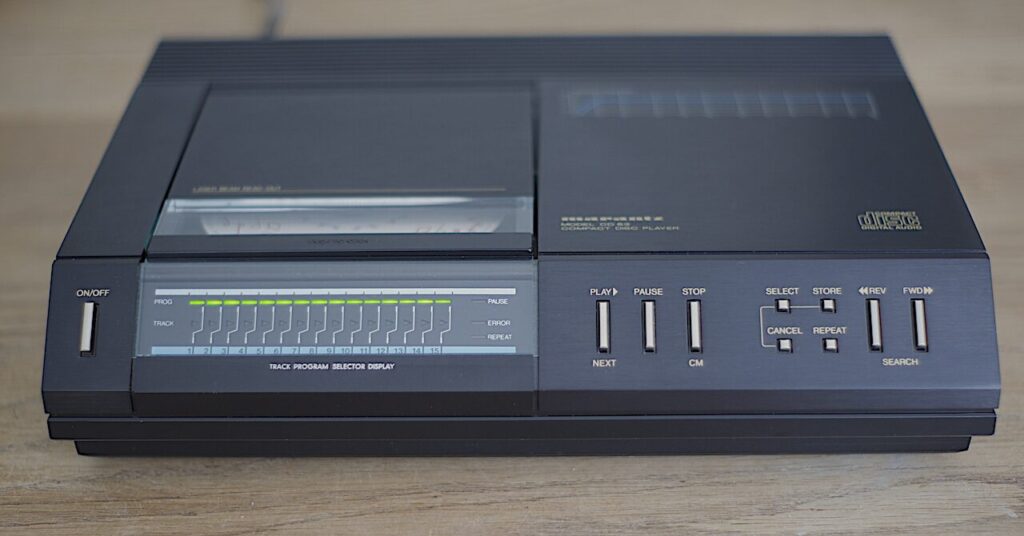
How good was it objectively? Not particularly good. It was a 14 bit player with 4x oversampling. The upshot was it managed a SNR of 90db (equivalent to about 15 bits in new money) , this is pretty dismal by today’s digital high res standards, but compared to a vinyl system that frequently had irritatingly audible extraneous noise it was wonderous.
Since then digital audio has improved massively for most consumer level products. For context my desktop USB powered DAC & Headphone amplifier which can handle high def (up to absurd bit depths and sampling rates) unit cost $99 and has measured SNR of about 117db or over 19 bits of resolution. I can play back a digital silence track on my Topping DX1 at high gain with good headphones on and at full volume and I hear no noise at all. Generally if you want a poor digital audio product these days you have to spend a lot of money. I will not mention any by name…libel laws!
How much progress has been made in vinyl playback? Not very much you might think given the immutable laws of physics and the physical processes involved. You would be half correct. The methods for recording sound onto LP have changed little in the last 70 years but the use of computer control on cutting heads allows finer control over the frequencies and levels that can be cut. The limits remain the same but they can be exploited more effectively, basically squeezing more performance. At the other end what about playback equipment.?
Over the last 70 years there have been many attempts to overcome the limits of vinyl playback. To deal with tracking issues there have been linear tracking turntables. To deal with the physical contact problems (wear and noise) there have been Turntables that read LPs using lasers. Neither of these has persisted much outside niche applications (such as archival) and the model of a traditional turntable remains much the same as it was in 1955.
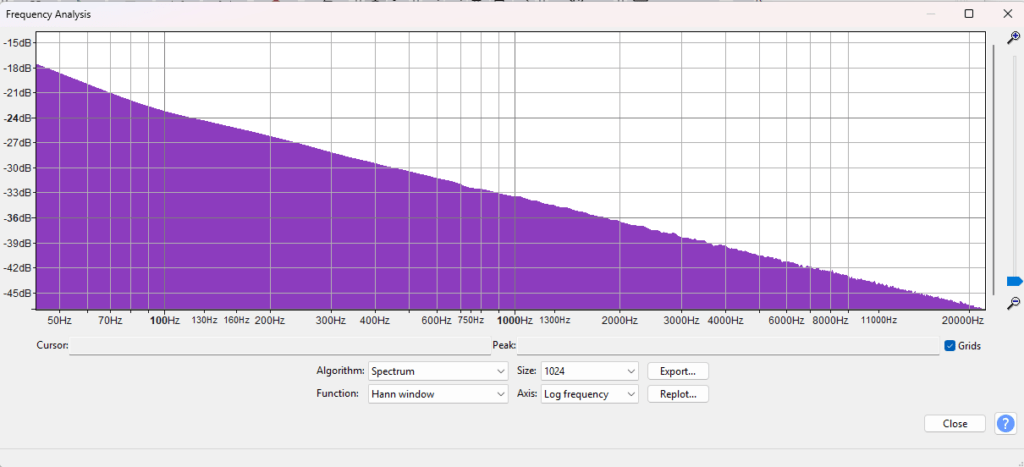
More expensive turntable systems can boast better speed stability, lower noise breakthrough, massive plinths and platters, better frequency responses, quieter motors and bearings and less resonant tonearms. It is possible to hypothesize a future “perfect” LP playback system that adds no extra noise. However the incipient noise will still be there. In this discussion we see that even a groove with no signal encoded will have significant noise.
The case for Vinyl
There are numerous arguments in favour of vinyl. The most obvious one is that some music listeners just prefer the sound of records. Vinyl can sound very good. At high enough levels to drown out the noise even my poor Rega system sounded very good. Other sources of preference typically cited include the large artwork, the rituals, the concentration required, the tactile nature of the experience, the unavailability of some music on other media, nostalgia and so on. We can love the sound of vinyl while not ignoring the limitations. However some vinyl fans have a need to support their preference with calls to some technical superiorities of vinyl, the reasoning goes “If I prefer it, it must be somehow superior”. Leaving aside human psychology could there be any mileage in the argument for technical superiority of vinyl?
Technical Superiority of vinyl ?
Higher frequencies: If we limit digital to 1984 level 44.1Khz sampling (covering the audible frequencies from 20 to 20Khz) then there is an argument that cartridges can easily reproduce frequencies well above 20Khz, some amplifiers can handle > 20Khz and some speakers can reproduce frequencies above 20khz although not with the same energy supplied generally about 3db down. The highest fundamental note in music is about 8Khz (B octave 8) . Exotic instruments such as the Balinese Gamelan can output harmonics of over 50Khz, however to even reproduce this requires specialist super tweeters. Is this clearly inaudible content perceived in any way? You can google “Oohashi hypersonic” if you like but the conclusion is …very unlikely. Of course in 2026 (or whenever you are reading this) we can trivially record music digitally at 96Khz if we really want to push the available frequencies to 48Khz. However, sampling at 96Khz does have some inherent problems such as ultrasonic noise potentially folding back into the audible range causing distortion.
Next up “Vinyl has infinite resolution, digital is just an approximation“. This is where intuition and physics disagree. The premise is that since vinyl playback is continuously variable and not sampled it must have infinite resolution.
However continuous and infinite are far from the same thing. Let us say that a cartridge has a maximum output of 2000µV (microvolts) and a minimum output of 0µV. There are theoretically an infinite number of voltages between 0µV and 2000µV for instance 1000.1, 1000,01, 1000.001 and so on and a cartridge will be able to output any of those values hence it has infinite resolution. Not so fast! If this were the case then vinyl would have infinitely high SNR and an infinite Dynamic range. We know this is simply not true. Even if the cartridge was capable of such quality the molecular structure of a vinyl LP does not support this level of resolution here is an excellent explanation by Dr. Jim LeSurf (ex St Andrews University Physics lecturer) .
Now “Vinyl is less compressed than digital“. There is perhaps some truth to this. You can have LP and CD versions of a track that have very different dynamics where the LP version may have a much higher dynamic range. There is a lot going on here. In the early days of CD engineers used to recording for analog had to adapt to engineering for digital. Able to exploit a greater dynamic range some chose to create hot recordings with most of the sound at very high levels not typically playable on vinyl due to the physical limits. This bleeds into the so called “Loudness wars” where engineers produce heavily saturated recordings especially for popular music. Luckily classical music engineers by and large knew how to exploit the dynamic range properly. This argument however takes a limit in the format and turns it into virtue, whereas in fact the issue is of not using the digital technology optimally. The usable dynamic range of digital remains greater than that of vinyl.
“Digital is sampled so throws a lot of information away while analog captures it all.” If analog captured it all it would have the infinite properties mentioned above. This argument is based on (often willful) misunderstanding of digital audio in general and sampling in particular (see also digital sampling creates stair steps). Monty from xiph.org can explain this better than me.
In short for a bandwidth limited signal if the sampling rate is 2x the highest frequency component then any arbitrarily complex waveform can be sampled and reconstructed perfectly. The CD standard 44.1Khz sampling rate easily captures frequencies up to 20Khz which is where hearing (for all but very young people ) stops. This is derived from the work of Harry Nyquist and Claude Shannon and is a foundation of digital communication.
The above myth can almost be forgiven if we replace digital with MP3 (or other lossy encoders). Lossy compression is based on now well tested psychoacoustic models and it does discard some information. But this is not random or capricious. The lossy compression algorithms discard data that we will not normally hear. A common approach here is to invoke the concept of masking. If a music sample contains two frequencies that are quite proximal then the louder signal may render the quieter signal inaudible.
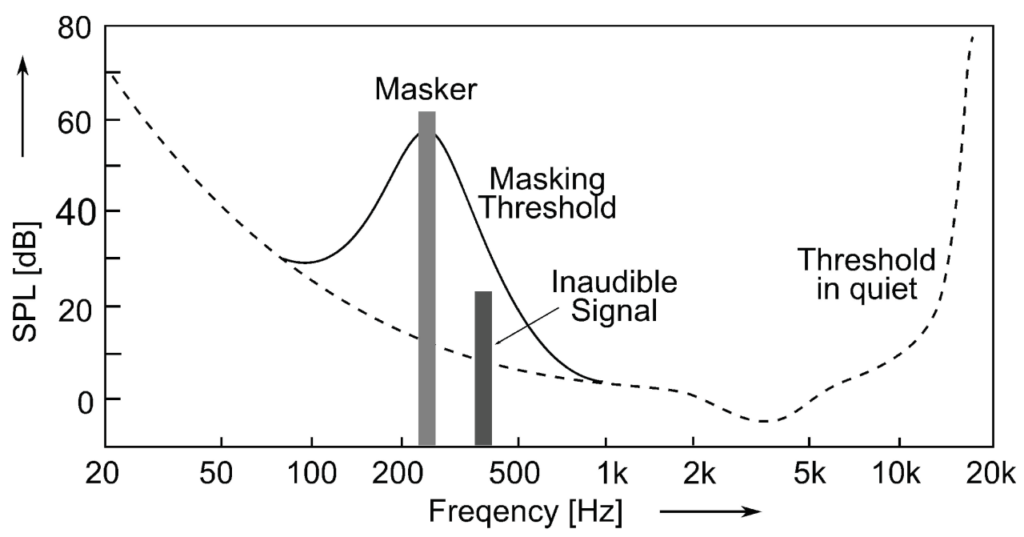
We can thus throw away the masked signal thus reducing the data requirements. There are other techniques used in lossy sampling for instance they may involve discarding some high frequency components i.e. those above 16Khz. Depending on how aggressive the algorithms are we might end up with a file that is 1/10th to 1/5th of the size of the original. Typically we express the data requirement of MP3 in Kbits per second. Since storage is so cheap these days it is hardly worth it .
But is high bitrate MP3 perceptually transparent? That very much depends on the listener. There are plenty of online tests available you can try yourself. On the whole relatively few listeners can reliably detect the difference between high bitrate MP3 (320kbs or VBR 0) and uncompressed audio. The only time I was able to reliably discern the difference between uncompressed and lossy compressed audio was a Dr. Feelgood track where the conversion to MP3 had pushed the peak values above 0db for some samples resulting in audible clipping. Dropping the source level by 3db and re-encoding made this clipping go away and I was no longer able to detect a difference.
This LP sounds better than the CD/Digital file of the same music
The LP and the CD version of a track may have very different mastering. The LP version may have better dynamics compared to a poorly mastered CD of the same music (see Loudness wars). Sadly you can find many examples of modern digital remasters with far worse dynamic ranges than the original LP releases or even early CD releases. This problem is of course an implementation issue and does not indicate any fundamental technical superiority of the analog chain. Thankfully classical digital audio tends to be better mastered.
While rare it is not impossible to get really bad CD players and music servers that have audible problems. A good LP system would sound preferable to a very poor digital system.