

Research Overview
In my initial studies, I developed an analytical framework by which patterns of adaptive role-behaviors in online learning communities could be related to peer learner influence. The framework identified eight key role-behaviors of social engagement in a community of inquiry, ranging in levels of influence from none (vicarious learner), through simple acknowledgement of others contributions, to “high impact” behaviors through which iterative collaborative knowledge building is enacted (initiator, facilitator and complicator role-behaviors).
Qualitatively different levels of collaborative student engagement were associated with the different degrees of engagement (Waters and Gasson, 2005). In a second study, I demonstrated that learner engagement appears to be correlated with specific role-behaviors that develop, complicate, and redirect the collective understanding of an online community of learners (Waters and Gasson, 2006).
In a subsequent analysis, I identified key student participants as “thought-leaders,” whose learning role-behaviors provide the basis for collaborative knowledge-building in a community of learning (Waters and Gasson, 2007). Further study employed quantitative measures of social network positioning to demonstrate that students’ centrality and connectedness in an online community of learning were closely related to their predominant patterns of role-behavior as peer-learners (Waters, 2008). This study provided a measure of the degree to which specific student thought-leaders complicate and redirect group discussions, that was validated in my dissertation study (2009).
I developed a coherent framework to explain peer-learner role-behaviors, that was validated in subsequent qualitative and quantitative analytical studies, then used the framework to assess individual student engagement in online learning communities and to explore the role of peer learning.
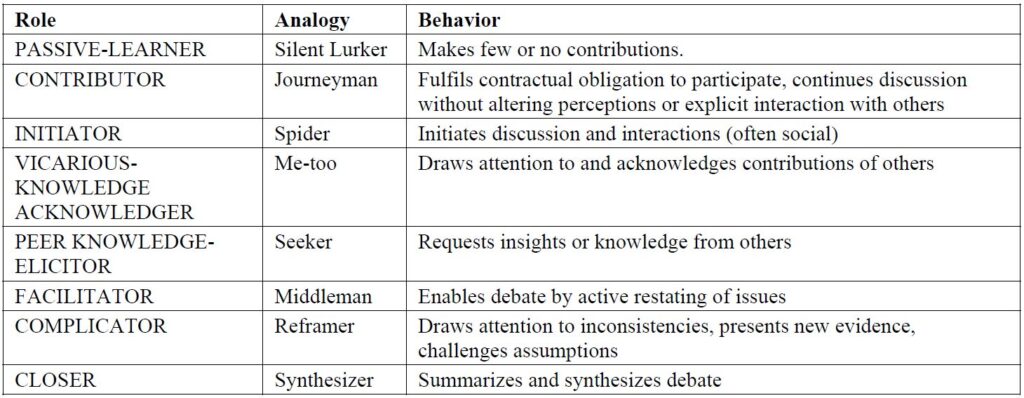
Categories of Student Role-Behaviors Observed In Online Peer-Learning Communities
My findings suggest that measures of peer centrality (as suggested by social network analyses), while useful in providing measures of interaction, are too simplistic to explain the differential impact of different participant contributors. Instead. we need to examine how an ability to critique, build upon (develop) emerging models of a situation, guide additional debate, and challenge shared assumptions underpin a group’s ability to abstract “lessons learned” that allow them to recognize and manage similar situations in the real world.
From a content analysis of student interactions in an online course, I discovered that the attention paid to peer-learners appeared to be related strongly to social influence. Patterns of student interaction indicated that students engaged in three progressive levels of community engagement: Participation, Involvement, and Social Engagement. From an instructional perspective, identifying key thought-leaders early in a course and encouraging them to share their knowledge, led to high levels of involvement with course topics. In turn, this led to both individual and community learning, as thought-leaders interacted with others. Encouraging students to critique the emerging community understanding, and to add to it, based on their own experience, led to renewed cycles of learning.

Levels of Metacognitive Learning, as Peer-Learners Interact with Thought-Leaders To Build Abstract Community Models of How a Situation Works
The findings challenge the assumption that a participatory democracy (Dewey, 1916) is the optimal model to support constructivist student learning in online environments. The findings suggest that gentle encouragement of a “benevolent oligarchy” of thought-leaders may be the key to the constructivist knowledge construction that underlies peer-learning as a core mechanism of social engagement in online education environments.
As an HCI researcher, I developed an analytical framework by which patterns of adaptive role-behaviors in online learning communities could be related to peer learner influence. The framework identified eight key role-behaviors of social engagement in a community of inquiry, ranging in levels of influence from none (vicarious learner), through simple acknowledgement of others contributions, to “high impact” behaviors through which iterative collaborative knowledge building is enacted (initiator, facilitator and complicator role-behaviors).
This framework was applied to scaffold graduate IS courses in professionally-oriented online knowledge communities. The objective was to identify thought-leaders in the community who possessed relevant domain knowledge for various application areas, and to investigate community learning mechanisms that led to the transfer of knowledge across peer-learners. Three aspects of domain-interest were discovered to govern effective knowledge-transfer:
- The question topic related explicitly to the course learning objectives (“at the end of this course you will be able to …”);
- The question domain related to their professional interests (i.e. answering it would help in job advancement or recruitment activities);
- The question identified clear experiential learning outcomes that allowed students to:
- practice professional skills
- develop contextually-situated expertise, or
- acquire domain-relevant knowledge.
The difference between questions/topics that engaged students for one of these reasons and those that did not motivate students was clear.
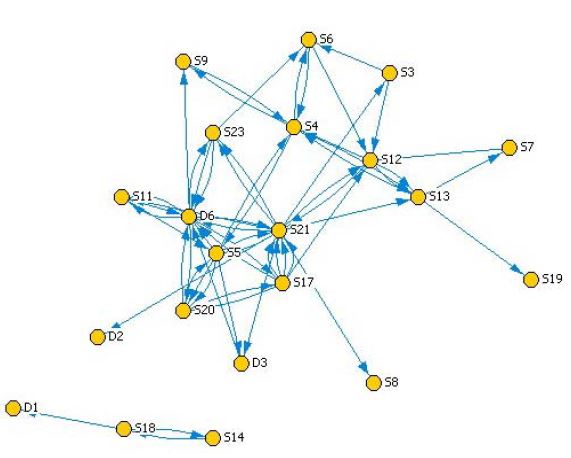
Students engaged in peer-learning, through interactions with experienced, knowledgeable community members
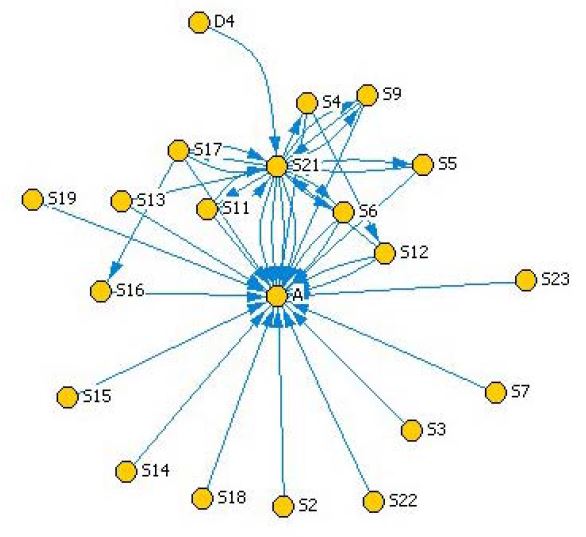
Students interact mainly with instructor, although a knowledgeable student thought-leader also guides community understanding on this topic
In the former case, students engaged with each other in peer-learning, with recognized thought-leaders (students who had direct experience of similar situations) guiding the communal understanding. In the latter case, students mainly posted “contractual” (required) interactions with the instructor (node A in the second social-network-map), with one main thought-leader emerging to guide part of the discussion and stimulate interest in a more exploratory subset of the community.
Other projects in which I was involved include:
- Gathering requirements for an early human-centered, collaborative learning system at Heriot-Watt University
- The evaluation of graphical passwords as an alternative to remembering long strings of alphanumeric characters (https://xkcd.com/936/) – I was famous at Drexel University for importuning women in the corridors and admin offices, as we attempted to recruit a gender-balanced research subject sample!
- A survey of the state of knowledge with regard to annotation and metadata for recorded music.
- Developing a framework for scaffolding and guiding collaborative knowledge-sharing behaviors in online graduate learning communities.
References
S Gasson, J Waters (2018) Simulating experiential learning in professional online courses, The Data Base for Advances in Information Systems (SIGMIS) – dl.acm.org
Waters, J. (2012) “Thought-Leaders In Asynchronous Online Learning Environments.” Journal of Asynchronous Learning Networks, 16 (1)
Waters, J. and Allen, R.B. (2010) “Music Metadata in a New Key: Metadata and Annotation for Music in a Digital World. “ Journal of Library Metadata, 10 (4), 238-256
Waters, J. (2009). Engagement, role-behaviors and thought-leaders: an analysis of student behavior in
asynchronous online learning environments [PhD Dissertation, Drexel University]. https://doi.org/10.17918/etd-3120
Wiedenbeck, S., Waters, J., Birget, J.C., Brodskiy, A., Memon, N. (2005) “PassPoints: Design and longitudinal evaluation of a graphical password system,” International J. of Human-Computer Studies (Special Issue on HCI Research in Privacy and Security), 63 (1-2), 102-127.